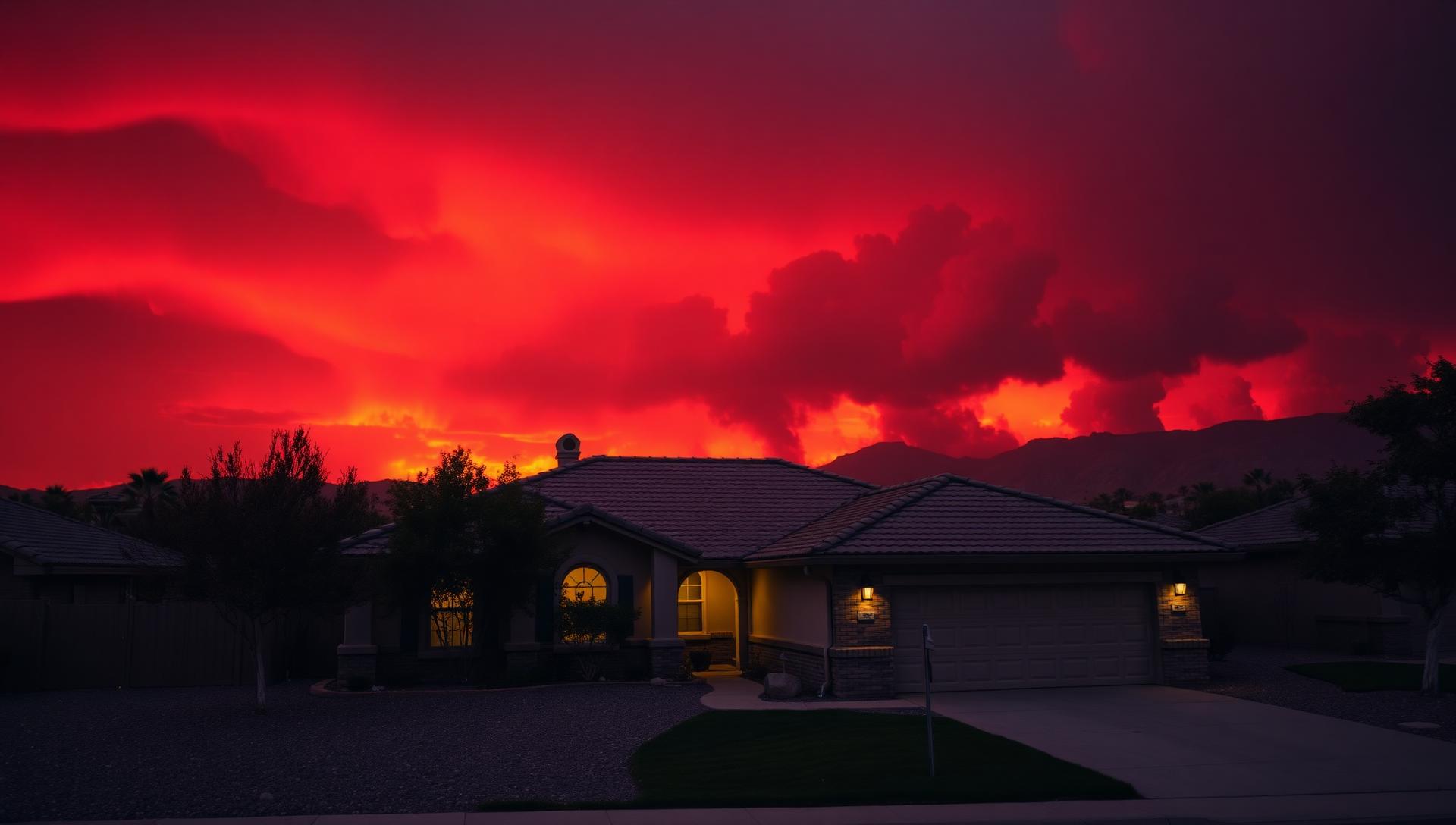
1. Why wildfire is different from other disasters
Speed, wind-driven embers, and the Wildland-Urban Interface — wildfire behaves nothing like a storm or a flood.
Hurricanes announce themselves days in advance. Wildfires are routinely reported, red-flagged, and at your property line within hours — sometimes minutes. Wind-driven fires can throw embers a mile or more ahead of the flame front, igniting homes long before any visible fire arrives. Studies of past wildfire disasters (IBHS, NFPA) attribute up to 90% of home ignitions to embers, not the flame front itself.
The most exposed properties sit in the Wildland-Urban Interface (WUI) — where homes meet vegetation. That's foothills, canyons, forested suburbs, and mountain communities across the West and the Southeast. If your home is in the WUI, your survivability is decided by two things: what you did to your home and yard before the fire, and how quickly you evacuate when told.
2. Defensible space & home hardening
Zones 0, 1, and 2 around the home — plus the roof, vents, and openings that decide whether embers get inside.
Reference: Ready.gov Wildfires and the NFPA Firewise USA program.
- Zone 0 (0–5 ft) — ember-resistant. Non-combustible only. Gravel, hardscape, or bare mineral soil. No bark mulch, no wood chips, no plants under vents or windows. Remove any wood fencing that attaches directly to the house — replace the last 5 ft with metal.
- Zone 1 (5–30 ft) — lean, clean, green. Irrigated, well-spaced, low-growing plants. Keep grass mowed. Remove dead vegetation, dry needles, and leaves — from the ground and from the roof and gutters. Trim tree limbs at least 10 ft from the house.
- Zone 2 (30–100 ft) — reduced fuel. Mowed grass, spaced trees, no ladder fuels connecting the ground to the tree canopy. Thin dense brush. Follow local rules — some Western states now require Zone 0 by law and inspect it.
- Class-A fire-rated roof. The single highest-impact upgrade for a home in fire country. Asphalt Class A, metal, tile, or slate. Avoid untreated wood shakes. Keep the roof and gutters clear of leaves and needles year-round.
- Ember-resistant vents & screens. Cover all vents, soffits, and openings with 1/8-inch metal mesh or install ember-resistant vents (WUI-rated). Embers entering an attic vent ignite most homes lost in a wildfire.
- Gutter guards & window upgrades. Install non-combustible gutter guards. Consider dual-pane tempered glass windows — single-pane windows crack in radiant heat and let flame inside.
- Sheds, fences, decks, woodpiles. Move woodpiles at least 30 ft from the house. Store propane tanks upright and clear of vegetation. Enclose deck undersides so embers can't drift underneath.
3. Build your home inventory long before wildfire season
Total-loss wildfire claims require a room-by-room inventory of everything you owned — and it's impossible to recreate from memory once your home is gone.
Adjusters pay contents claims on proof. After a wildfire total loss there's nothing left to photograph, no drawers to open, no serial numbers to read. Homeowners without a pre-loss inventory routinely settle for a fraction of what they actually lost — not because insurers act in bad faith, but because you can't prove what you can't remember.
- Walk every room with your phone and record slow, deliberate video. Open closets, drawers, and cabinets.
- Photograph the front of every appliance and its data plate (brand, model, serial number).
- Keep receipts, order confirmations, and warranty registrations for expensive items.
- Store the whole record off-site — cloud storage, an email to yourself, or a service that keeps a timestamped copy. If it lives only on your home computer, it burns with the house.
4. The wildfire insurance crisis
Insurers are non-renewing high-risk homes across the West — and the FAIR Plan is often the last option. Home hardening is what keeps you insurable.
A decade of billion-dollar wildfire losses — Camp Fire, Marshall Fire, Lahaina, the LA fires — has repriced the risk. Several major carriers have paused new business or non-renewed wildfire-exposed homes in California, Oregon, Colorado, and neighboring states. Reinsurance costs have risen sharply, and historical loss models no longer predict what actually happens in a WUI fire year.
A FAIR Plan (Fair Access to Insurance Requirements) is a state-created insurance pool that provides basic property coverage to homeowners who can't get a policy on the open market — the insurer of last resort. Coverage is typically more limited (fire, lightning, and internal explosion) and more expensive; most homeowners pair a FAIR Plan fire policy with a separate "wrap-around" or DIC (difference-in-conditions) policy to fill the gaps.
What tips the scale back in your favor: documented home hardening and defensible-space work. Class-A roofs, ember-resistant vents, cleared Zone 0, and Firewise-community participation increasingly earn discounts — and in some markets, restore eligibility for standard coverage. Ask your agent what mitigation credits apply, get every answer in writing, and check your state page for the specific FAIR Plan and rules that apply to you.
5. Evacuation planning & go-bag
Know your zone, sign up for alerts, and follow "Ready, Set, Go" — leave early, not late.
- Know your zone & alerts. Look up your evacuation zone through your county or state emergency management site before fire season. Sign up for local alerts (many counties use Genasys/Zonehaven, Nixle, or CodeRED) and enable Wireless Emergency Alerts on your phone.
- Ready, Set, Go. READY: home hardened, defensible space in, go-bag packed. SET: fire in the area — cars pointed out, pets contained, review the plan. GO: evacuate immediately when told, or sooner if you feel unsafe. Don't wait for the last warning.
- Go-bag basics (kept packed year-round). N95 masks and goggles, prescription meds, phone chargers + battery pack, sturdy shoes and long sleeves (cotton or wool, not synthetic), cash, copies of ID and insurance policies, and a printed list of critical account and contact info.
- Pets & livestock. Carriers and leashes staged by the door. Microchip and current photos. For horses/livestock, know your trailer routes and pre-arrange boarding — pre-evacuate animals early.
- Important documents. IDs, insurance declarations, home inventory link, medication list, and any legal documents you'd need to rebuild your life. Keep digital copies in the cloud so you don't need to grab paper.
- What to grab if there's time. Small irreplaceables only — photo albums, hard drives, family heirlooms. Never risk your life for possessions. Your home inventory should already be off-site.
6. After a wildfire: first steps
Don't return until authorities clear the area — post-fire hazards kill and injure people every year.
- Do not return until authorities clear the area. Active hot spots, downed power lines, damaged gas lines, and unstable structures kill returning residents every year.
- Wear PPE — ash and debris are toxic. Post-fire ash contains heavy metals, asbestos, and combustion byproducts. Wear an N95 or P100 mask, gloves, long sleeves, long pants, and sturdy shoes any time you're on the site.
- Document all damage before any cleanup. Photograph and video every angle before you touch anything — exterior, interior, melted appliances, contents of every room and closet. Your pre-loss inventory + these post-loss images are the foundation of your claim.
- Beware post-fire debris flows. Burn scars lose the vegetation that holds soil in place. The next rain — even a modest one — can trigger mudslides and debris flows through and below burned areas. Watch NWS and county alerts closely for the first two winters after a fire.
- Watch for post-fire contractor scams. Never pay in full up front, never sign an assignment-of-benefits form under pressure, and verify a contractor's license before hiring for debris removal or rebuild.
7. Filing a wildfire insurance claim
Use every coverage on your policy — including the ones most homeowners don't know they have.
- Call your insurer's 24/7 claims line. Have your policy number ready. Get a claim number and adjuster name in writing.
- Trigger Additional Living Expenses (ALE) immediately. If you evacuate or your home is uninhabitable, ALE covers hotel, temporary rental, meals, pet boarding, and other reasonable extra costs. Keep every receipt from the day you evacuated.
- Submit your pre-loss inventory + post-loss documentation. Room-by-room video, photos of appliance data plates, receipts, and the post-fire damage photos. Include a written narrative of what happened.
- Claim smoke damage separately and thoroughly. Even homes that don't burn often suffer heavy smoke damage — HVAC systems, insulation, drywall, and porous belongings. Insist on professional testing and remediation, not a wipe-down.
- Meet the adjuster on-site once cleared. Walk them through everything — including easy-to-miss items like melted electrical panels, HVAC condensers, and detached structures.
- Review the itemized settlement carefully. Confirm the correct wildfire deductible was applied. If items are missing or valued low, respond in writing with your evidence.
- Keep a claims diary. Date, person, phone number, what was said. Wildfire claims routinely take a year or more — the diary is the most useful document you'll keep.
Note: Some high-risk properties now carry a separate wildfire deductible or exclusions. Read your declarations page before fire season — not after a loss.
8. Find your state
Local wildfire rules, state FAIR Plan info, and claim steps by state. California, Oregon, Colorado, Arizona, Washington, Nevada, Utah, Idaho, Montana, New Mexico, Wyoming, and Hawaii are all live.
Frequently asked questions
Official Resources
-
Ready.gov — WildfiresOfficial federal wildfire preparedness guide
-
FEMAFederal Emergency Management Agency
-
National Interagency Fire CenterLive national wildfire situation & incident info
-
AirNow — Smoke & Air QualityReal-time smoke, AQI, and fire maps
-
DisasterAssistance.govApply for federal disaster help
-
NFPA Firewise USADefensible space + home hardening standards